Two Zeros, Twice the Trouble: The Extra Pocket That Shapes Every American Roulette Table
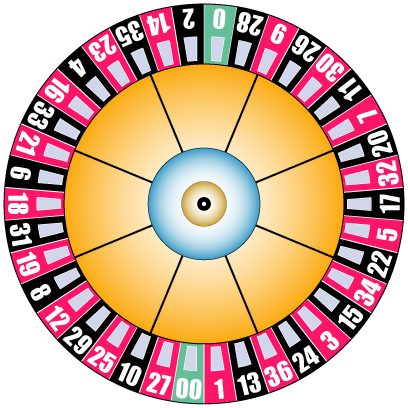
Photo: Film8ker at English Wikibooks, Public domain, via Wikimedia Commons
Stand at a roulette table in Las Vegas, Reno, or Atlantic City and you'll notice something a European player never sees: two green pockets sitting across the wheel from each other. One says 0. The other says 00.
It looks harmless. It looks like tradition. But that second zero is the reason American roulette quietly takes more from players than almost any other table game on the floor.
One Pocket, One Big Difference
A European wheel has 37 pockets: numbers 1 through 36 plus a single zero. An American wheel has 38, because of that extra double zero.
Here's why that matters. Every standard bet on the layout — red or black, odd or even, a single number, whatever — pays out as if there were only 36 pockets. A straight-up bet on 17 pays 35 to 1. An even-money bet pays 1 to 1. The math assumes a fair 36-pocket world.
But the wheel doesn't live in that world. It has 37 or 38 pockets, and the zeros belong to the house. Every extra zero is another slice of the wheel where the casino wins no matter what you bet.
- European single-zero wheel: house edge of about 2.70%
- American double-zero wheel: house edge of about 5.26%
Nearly double. Same game. Same payouts. One extra digit.
What That Extra Zero Actually Costs
Let's put real dollars on it. Suppose you bet $10 per spin on red, playing 100 spins in an evening — a very normal pace for a US casino floor.
On a European wheel, your expected loss over those 100 spins is roughly $27. On an American wheel, it's about $53. The difference between the two wheels, for one ordinary night of play, is the price of a nice dinner on the Strip.
Stretch it out. A regular player who logs 1,000 spins a month at $10 a spin is looking at an expected cost of around $530 on a double-zero wheel versus $270 on a single-zero wheel. Over a year, that's more than $3,000 — all attributable to one pocket.
And it's not just even-money bets. On an American wheel, a straight-up number bet carries the same 5.26% edge. On a European wheel, that bet runs 2.70%. There is no bet on the American layout that escapes the double zero's tax.
How America Ended Up With the Worse Wheel
The double zero isn't an American invention gone wrong — it's actually the original design. When roulette made its way from France to gambling halls in the 18th and 19th centuries, wheels commonly featured both a 0 and a 00. The single-zero wheel was the innovation, introduced in Germany and later popularized in Monte Carlo as a way to attract players with better odds.
The single-zero version caught on across Europe. But in America, the game traveled a different road. Gambling in the 1800s spread through riverboats, saloons, and makeshift casinos where operators weren't exactly competing on player value. The double-zero wheel, with its fatter house edge, stuck. By the time legalized casino gambling matured in Nevada, the American wheel was simply the standard.
Modern US casinos have no strong incentive to change it. The double-zero wheel earns roughly twice as much per dollar wagered, and most casual players never notice the difference. In a town built on free drinks and comped rooms, the extra zero is just another quiet revenue line.
The One Exception Worth Knowing
There is a partial fix hiding on some American tables: the surrender rule (sometimes called la partage on European layouts). On even-money bets, if the ball lands on 0 or 00, the house takes only half your bet instead of all of it.
That single rule cuts the edge on even-money bets from 5.26% down to about 2.63%. Not every casino offers it, and not every dealer advertises it, so it never hurts to ask before you sit down. A handful of Vegas properties — and some rooms in Reno and Atlantic City — run single-zero wheels too, usually with a $25 or higher minimum. If your bankroll can handle the minimum, those tables are mathematically the best roulette deal in the building.
Why the Worse Wheel Wins Anyway
You might wonder why players keep lining up at double-zero tables when better versions exist. A few reasons:
- Habit and availability. In most US casinos, double-zero is the default. You'd have to go looking for an alternative.
- Invisible math. A 2.56% difference doesn't show up in any single spin. It only reveals itself across hundreds of bets, which is exactly where most players aren't looking.
- Atmosphere over odds. Roulette is a social game. People pick tables for the crowd, the dealer, the vibe — not the wheel configuration.
None of that makes the double-zero wheel a scam. It's a legal, transparent game with published odds. But it does mean that every time you choose it over a single-zero alternative, you're agreeing to pay roughly twice the house's rent for the same entertainment.
The Takeaway
Numbers don't lie, but they do whisper. The double zero never announces itself. It just sits there in green, taking a little extra from every spin, every session, every trip. If you love roulette, keep playing — but know your numbers before you sit down. Seek out single-zero wheels when you can, ask about surrender when you can't, and never forget that in American roulette, the most expensive pocket on the wheel is the one that pays nothing at all.